French President Emmanuel Macron has accused various foreign leaders of exploiting the recent French riots for electoral purposes. Following widespread violence that gripped cities such as Paris, Lyon, and Marseille, Macron stated that certain politicians are campaigning "at France's expense" during their own domestic election cycles. The unrest, which emerged from cost-of-living protests and student demonstrations, has been exacerbated by the rapid spread of AI-generated disinformation. This article examines Macron's allegations, the specific claims made by international leaders, and the role of digital manipulation in fueling the chaos.
Why did Emmanuel Macron accuse foreign leaders of exploiting the French riots?
President Emmanuel Macron claims that foreign political figures are utilizing the civil unrest in France to bolster their own domestic political agendas. Speaking from Doha, Qatar, Macron suggested that these leaders are in "campaign mode," using the violence to appeal to their respective electorates. He specifically pointed to leaders "on the other side of the Atlantic" and those within the Middle East, though he did not name them directly in his initial remarks.
The French President's frustration stems from what he perceives as a distortion of the facts surrounding the riots. He argued that while there was no direct foreign interference in the physical events themselves, there has been significant "foreign manipulation of information" following the outbreaks of violence. According to Macron, this manipulation has led to "unacceptable and stupid comments" from international figures that misrepresent the nature of the unrest.
Macron has been particularly vocal against narratives suggesting that France is facing an "invasion" of migrants or Islamists. He characterized these claims as entirely false, asserting that they serve only to fuel division rather than address the underlying socio-economic issues that triggered the protests in the first place.
How have international leaders responded to the unrest?
International leaders have utilized the French riots to highlight their own political stances on immigration and religious extremism. Most notably, Israeli Prime Minister Benjamin Netanyahu and US former President Donald Trump have made public comments that align with the narratives Macron has sought to debunk.
Statements from Benjamin Netanyahu and Donald Trump
On Tuesday, Israeli Prime Minister Benjamin Netanyahu addressed the situation during an interview with the i24 channel. He suggested that France is experiencing an "invasion of extremist Islam," citing the country's large Muslim minority. Netanyahu referenced a previous conversation with Macron regarding the Hamas attacks of October 7, 2023, suggesting that the instability in France is a direct consequence of failing to eliminate extremist threats elsewhere.
Similarly, Donald Trump has linked the French riots to broader trends of mass immigration. During his remarks, Trump argued that the turmoil in France and Italy is not a matter of school-related grievances, as some claim, but is instead a result of "people coming into the countries that hate the country." He concluded by urging Macron to "close your borders" to regain control.
What role did AI and disinformation play in the violence?
Artificial intelligence and coordinated disinformation campaigns have significantly amplified the impact of the French riots by spreading false narratives and fabricated media. Security officials and researchers have identified several layers of digital manipulation that contributed to the atmosphere of chaos.
According to a report by the Financial Times, EU regulators are currently investigating potential foreign online interference. Unnamed security officials have suggested that pro-Russian and far-right social media accounts have been instrumental in spreading violent footage to sow further discord. There are also suspicions that messaging linked to the unrest may have originated from Iran or Algeria.
Researchers have identified specific patterns in these digital operations:
- Pro-Kremlin Influence: David Colon, a researcher at Sciences Po, noted that influencers linked to the Russian "Storm-1516" campaign have amplified the events and disseminated false narratives.
- Matryoshka Operation: BBC Verify identified over 15 examples of fake news videos attributed to a Russian disinformation operation known as "Matryoshka." These videos often use branding that mimics legitimate French news outlets like Le Monde or France 24.
- AI-Generated Imagery: Viral images, such as a widely shared depiction of an elderly couple being robbed in Paris, were found to be entirely fabricated by AI.
While the direct reach of some individual videos may be limited, experts warn that the strategic focus on amplifying domestic unrest is a consistent tactic used in modern hybrid warfare.
The impact of the Matryoshka disinformation campaign
The Matryoshka operation is particularly sophisticated because it exploits the visual language of trusted media. By using near-identical branding to established organizations such as Euronews and France 24, the operation creates a veneer of legitimacy that makes it difficult for the average social media user to distinguish between reality and fabrication. This tactic is designed to erode public trust in official institutions and mainstream journalism, creating a vacuum that is easily filled by more radical or extremist viewpoints.
What were the primary causes and consequences of the riots?
The riots were the result of a complex intersection of long-standing social grievances and immediate triggers. While the violence was often framed through the lens of immigration by foreign commentators, the domestic reality involved student protests and cost-of-living concerns.
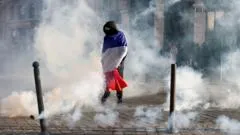
The unrest began on the fringes of protests regarding the cost of living and was further fueled by weeks of demonstrations by students concerning high school conditions. The government has acknowledged that police forces "lost control" during the height of the violence, which saw significant property damage, looting, and running battles in major cities including Paris, Lyon, Marseille, and Nice.
The legal and social consequences have been swift:
- Legal Action: Since the riots began, more than 800 individuals have been brought before the courts, and nearly 150 people have been jailed.
- Government Stance: President Macron has vowed an "uncompromising" approach toward what he describes as "agitators from ultra-left fringe groups," whom he blames for much of the escalation.
- Social Division: The riots have deepened existing divides within French society, particularly regarding the role of secularism, immigration, and the efficacy of law enforcement.
FAQ: French riots and disinformation
Why is France being accused of an "invasion" by foreign leaders?
Leaders like Benjamin Netanyahu have used the unrest to claim that France is being overwhelmed by "extremist Islam." This narrative focuses on France's large Muslim population to suggest that domestic instability is a direct result of uncontrolled immigration and religious extremism, rather than socio-economic factors.
How can AI-generated videos be identified as fake?
Many fake videos, such as those from the Matryoshka operation, use branding that mimics real news outlets. However, researchers look for inconsistencies in the footage, near-identical repetitive patterns across different accounts, and the lack of verification from the actual news organizations being impersonated.
What is the connection between Russia and the French riots?
Security officials and researchers have linked pro-Russian influencers to disinformation campaigns that amplify French unrest. These actors aim to sow chaos and weaken European stability by spreading false narratives and violent imagery through social media accounts associated with campaigns like Storm-1516.
Who is responsible for the AI image of the elderly couple in Paris?
The viral image of an elderly couple being robbed was created using ChatGPT by the team at Infos-Israel.News. While the creator expressed regret that the image was taken out of context, the fabricated image was shared millions of times without the necessary AI disclaimers.
What triggered the initial protests in France?
The unrest was primarily driven by cost-of-living protests and student demonstrations regarding conditions in high schools. While the resulting riots were later characterized by some as being about immigration, the domestic origins were rooted in economic and educational grievances.
Key takeaways
- President Macron accused foreign leaders of using French civil unrest for their own electoral gains.
- Disinformation campaigns, including the Russian Matryoshka operation, amplified the riots using fake news branding.
- AI-generated images, such as a fake robbery in Paris, reached millions of views without disclaimers.
- Nearly 150 people have been jailed following violence in cities like Paris and Lyon.
Synthesis of the geopolitical and social crisis
The recent riots in France represent more than a domestic policing challenge; they have become a flashpoint for international disinformation and geopolitical posturing. The convergence of genuine socio-economic grievances with sophisticated AI-driven manipulation has allowed foreign actors to project their own political narratives onto French soil. As President Macron seeks to maintain order and combat "foreign manipulation," the incident highlights the increasing difficulty of maintaining social cohesion in an era where digital falsehoods can be weaponized to exploit local volatility for global political ends.