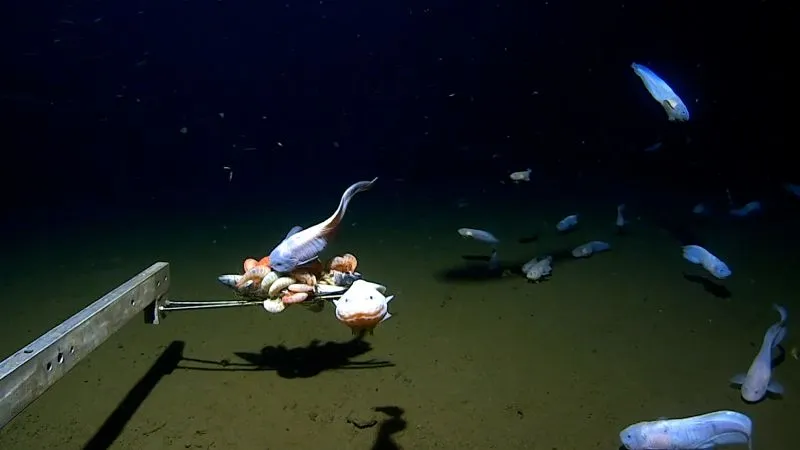
Where was the snailfish deepest fish discovered?
The unknown snailfish species was filmed in the deep-sea trenches located off the coast of Japan. This expedition targeted some of the most inaccessible regions of the ocean, specifically the hadal zone, which refers to the deepest parts of the ocean trenches. By utilizing specialized deep-sea camera technology, researchers were able to document life at depths that remain largely unexplored by humanity.
The expedition's focus on the Japanese trenches allowed scientists to observe how biological life adapts to the extreme environmental constraints found at the bottom of the world's oceans. These trenches act as isolated biological islands, potentially hosting species that exist nowhere else on Earth.
What makes this snailfish discovery significant?
This discovery is significant because it provides visual evidence of a previously unknown snailfish species thriving at depths of more than 27,000 feet. Finding life at such extreme pressures challenges our understanding of vertebrate physiology. Most known fish species cannot survive the crushing weight of the water column found at these depths, yet the snailfish appears to have evolved highly specialized biological mechanisms to endure these conditions.
The ability to capture high-definition footage of these creatures allows marine biologists to study their movement, feeding habits, and social interactions in their natural habitat. Previously, much of our knowledge regarding hadal life was limited to specimens brought up in physical traps, which often suffer damage during the ascent. Direct observation via remote cameras minimizes this disturbance.
Biological adaptations to extreme pressure
To survive at 27,000 feet, these snailfish must possess unique cellular and skeletal structures. At such depths, the pressure is hundreds of times greater than at the surface. Scientists believe that deep-sea snailfish may have evolved translucent skin, reduced bone density, and specialized proteins that prevent their cell membranes from collapsing under the immense weight of the ocean.
How do scientists film at such extreme depths?
Scientists utilize advanced remotely operated vehicles (ROVs) and deep-sea landers equipped with high-resolution cameras to reach the ocean floor. These devices must be engineered to withstand the extreme hydrostatic pressure found in trenches. The technology used in the Japan expedition allowed for the clear recording of the snailfish, providing a window into an environment that is otherwise pitch black and inaccessible to divers.
The deployment of these tools involves careful planning, as the descent to 27,000 feet takes a significant amount of time and requires precise buoyancy controls. Once on the seabed, the cameras and lights provide the necessary illumination to capture the subtle movements of deep-sea organisms, which often move slowly to conserve energy in a nutrient-scarce environment.
What are the implications for deep-sea exploration?
The sighting of this snailfish underscores the vast amount of biological diversity that remains uncatalogued in the Earth's oceans. Each successful expedition into the trenches reveals that the deep sea is not a barren wasteland, but a complex and active ecosystem. This discovery encourages further investment in deep-sea technology and marine research to better understand the global ocean's role in planetary health.
As technology continues to advance, the frequency of these discoveries is expected to increase. Understanding the life cycles of hadal species is crucial for assessing the impact of human activities, such as deep-sea mining or climate change, on the most remote parts of our planet. The snailfish serves as a biological indicator of the health and complexity of these hidden deep-sea realms.
FAQ: snailfish deepest fish
How deep was the snailfish filmed?
The snailfish was filmed at a depth of more than 27,000 feet. This depth places the creature within the hadal zone, the deepest layer of the ocean found in trenches, where environmental conditions are extremely harsh and high-pressure.
Where did the expedition take place?
The expedition took place in the ocean trenches located off the coast of Japan. These trenches provide a unique environment for studying specialized species that have adapted to the extreme depths of the Pacific Ocean's hadal zones.
What kind of fish is a snailfish?
A snailfish is a type of deep-sea fish that has become known for its ability to inhabit extreme depths. They are often characterized by their soft, somewhat gelatinous bodies, which help them withstand the intense pressure of the deep ocean.
Is this a new species?
Yes, the footage captured an unknown snailfish species. While snailfish are known to inhabit deep waters, this specific encounter provided scientists with visual evidence of a species that had not been previously documented at these specific depths.
Why is it hard to study these fish?
Studying these fish is difficult due to the extreme pressure and darkness of the deep ocean. Scientists must use highly specialized, pressure-resistant equipment and remote technology to observe life at depths exceeding 27,000 feet without destroying the specimens.
Key takeaways
- Scientists filmed an unknown snailfish species at depths exceeding 27,000 feet.
- The discovery occurred during a research expedition in trenches off the coast of Japan.
- The footage provides rare visual evidence of life in the ocean's hadal zone.
- Snailfish possess unique biological adaptations to survive extreme hydrostatic pressure.
The future of deep-sea research
The discovery of the snailfish at such extreme depths reinforces the necessity of continued exploration of the hadal zone. As we uncover more about the specialized life forms inhabiting these trenches, we gain a better understanding of the limits of life on Earth. This finding is not just a biological curiosity; it is a reminder of the immense, untapped knowledge residing in our oceans, waiting to be documented by the next generation of marine scientists and advanced deep-sea technologies.