What were the official results of the Israeli election?
The official results presented to President Herzog on Wednesday, November 5, 2026, confirm a fragmented Knesset with no clear parliamentary majority. According to the Central Elections Committee, the 120-seat legislature is split among several competing blocs, making the formation of a stable government a complex mathematical and political challenge.
Breakdown of the Knesset seats
The distribution of seats following the October 27 vote reveals a deeply divided electorate. Prime Minister Benjamin Netanyahu’s Likud party, supported by its far-right and ultra-Orthodox Jewish allies, secured a total of 53 seats. In contrast, Gadi Eisenkot’s centrist Yashar party, alongside three other Jewish opposition parties, captured 48 seats. This leaves a significant portion of the legislature held by Arab-led alliances.
A notable development in this election cycle was the performance of the United Arab List and the Joint List. These two Arab-led alliances won a combined 19 seats, driven by a surge in voter turnout within Arab communities. While these seats represent a significant bloc of power, they also introduce a layer of political complexity, as most Jewish parties had previously pledged not to include them in any coalition government.
How will President Herzog resolve the political impasse?
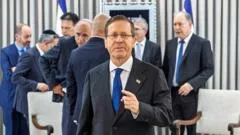
President Isaac Herzog has begun the formal process of consulting with party leaders to identify a candidate capable of building a working coalition. Although the Israeli presidency is largely a ceremonial role, the president holds significant discretionary power during periods of political instability. Under Israeli law, the president invites a Knesset member to form a government, providing that individual with a 28-day window to achieve a majority, which can be extended by an additional 14 days.
During his initial meetings, Herzog emphasized the necessity of compromise. He warned party leaders that if they wish to avoid the cost and instability of another round of elections, they must accept that "not every commitment and promise can be fulfilled" in the current political climate. The president’s goal is to facilitate the creation of a stable government that can serve the interests of the Israeli people despite the lack of a clear electoral winner.
What are the allegations regarding foreign interference?
The Shin Bet security service is currently investigating claims of foreign interference that may have influenced the electoral process. Central Elections Committee chairman Justice Noam Sohlberg stated that intelligence suggests a "widespread phenomenon involving the influx of substantial funds into Israel from foreign states," some of which are considered hostile to Israel. The investigation aims to determine the scale and specific impact of these funds on the election outcome.
One specific allegation involves claims that Qatar provided funding intended to boost voter turnout in Arab communities. While the Qatari foreign ministry has categorically denied these claims, the investigation remains ongoing. Justice Sohlberg noted that while these potential influences are serious, they are not expected to fundamentally alter the certified results of the election.
The tension between security and political legitimacy
The investigation has become a flashpoint for political conflict. National Security Minister Itamar Ben-Gvir, a far-right ally of Netanyahu, has called for the arrest and interrogation of Arab party leaders to clarify these suspicions. Conversely, Joint List chairman Yousef Jabareen has accused the Prime Minister’s camp of attempting to "steal the election from the public." This tension is further complicated by the role of the Attorney-General, Gali Baharav-Miara, who recently rejected a request from the Shin Bet chief to interrogate four Arab politicians due to a lack of evidence of wrongdoing.
How has the election deadlock impacted social cohesion?
The inconclusive results and the subsequent rhetoric have exacerbated existing divisions within Israeli society. President Herzog has taken a public stand against the use of inflammatory language, specifically condemning "coarseness and racist expressions" directed at Arab Israelis. He emphasized that the roughly 20% of the population who identify as Palestinian citizens of Israel must not be targeted with smears during this period of political uncertainty.
The rhetoric from various political factions has contributed to a sense of delegitimization. Gadi Eisenkot has accused the Netanyahu administration of conducting a "pogrom against democracy and the rule of law," while the Likud party has suggested that the Attorney-General is obstructing investigations into electoral manipulation. These accusations create a volatile environment where the peaceful transfer of power—a cornerstone of democratic stability, according to Justice Sohlberg—is being actively contested by major political players.
FAQ: Israel election deadlock
Who is tasked with forming the new government?
President Isaac Herzog is responsible for consulting with Knesset members to decide whom to task with forming a coalition. The chosen individual has 28 days, with a possible 14-day extension, to assemble a majority of at least 61 seats in the 120-member Knesset.
What is the role of Arab-led parties in the current deadlock?
The United Arab List and the Joint List won 19 seats combined, making them potential kingmakers in a highly fragmented parliament. However, their role is limited by the fact that most Jewish parties have pledged not to enter into coalition agreements with them.
Is there evidence that the election results were fraudulent?
No. Electoral officials and the Central Elections Committee stated there is no evidence of irregularities that would justify delaying the certification of the results. While foreign interference is being investigated, officials maintain that it will not change the fundamental outcome.
What is the Shin Bet investigating?
The Shin Bet is investigating allegations of foreign states injecting substantial funds into Israel to influence the election. This includes unsubstantiated claims regarding funding aimed at increasing voter turnout in specific communities, though the scale and impact are still being determined.
Why is the President's role important if it is ceremonial?
While the presidency is largely ceremonial, the president holds the critical constitutional power to break a deadlock by selecting a Knesset member to attempt coalition building. This discretion is vital for ensuring the continuity of government and avoiding frequent, costly elections.
Key takeaways
- No single political bloc secured a majority in the 120-seat Knesset following the October 27 election.
- President Herzog has begun formal consultations to find a candidate capable of forming a stable coalition.
- The Shin Bet is investigating potential foreign interference involving the influx of substantial external funds.
- Arab-led alliances won 19 seats, making them significant but politically isolated potential kingmakers.
The path toward stability
The resolution of the Israel election deadlock depends on whether political leaders can prioritize governance over ideological purity. The current landscape is defined by a struggle between the need for a functional coalition and the deep-seated distrust between the Likud-led bloc and the opposition. As President Herzog navigates these consultations, the stability of Israel's democratic institutions will be tested by both the technical challenges of coalition mathematics and the social challenges of a polarized electorate. The outcome will determine whether the country moves toward a new government or descends into a cycle of repeated elections.