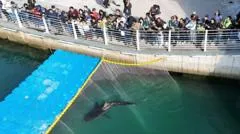
Why is Bukangi the shark returning to the Busan canal?
Bukangi the shark has repeatedly circled back to the mouth of the canal in Busan, even after a delicate eight-hour rescue operation successfully guided her toward the open sea on Wednesday. Authorities reported that on Thursday morning, the dusky shark managed to break through a newly installed barrier to re-enter the waterway. This behavior has forced rescuers to reinforce existing net layers to prevent a recurrence.
The shark's presence in the canal is believed to be linked to environmental factors. Experts suggest that unusually warm waters and an abundance of fish may have drawn the animal into the confined space. As global sea temperatures continue to rise annually, marine biologists warn that cities like Busan may encounter more frequent shark sightings in urban waterways in the future.
The cycle of return
The struggle to keep Bukangi in the open sea highlights the difficulty of managing displaced marine life in urban environments. After being guided through a harbour using large nets, the shark's immediate return to the canal suggests a strong biological or environmental pull toward the sheltered waters. Rescuers have had to transition from active guidance to defensive fortification, using multiple layers of netting to create a more permanent deterrent.
What was the impact of the shark on Busan's tourism?
The arrival of Bukangi the shark transformed a local canal into a major tourist attraction, drawing more than 1.6 million visitors over the course of her month-long stay. This sudden influx of interest provided a significant economic boost to the south-eastern port city, as the shark was informally embraced as a local mascot. The spectacle of a large predator in an urban waterway created a unique phenomenon that captured international attention.
The popularity of the shark was evidenced by the crowds that gathered at the park overlooking the canal. During the rescue operation, hundreds of spectators watched the proceedings, some cheering for the shark's departure and others waving goodbye. This level of public engagement is rare for wildlife incidents, turning a biological anomaly into a cultural event for the city of Busan.
How do local residents view the shark's relocation?
Public opinion in Busan remains deeply divided over whether Bukangi should remain in the canal or be forced into the open sea. The debate centers on the conflicting priorities of safety, animal welfare, and the perceived "right" of the shark to inhabit the space she has occupied for several weeks.
On one side of the debate, some residents argue that the canal has become the shark's home and that relocation is an unnecessary risk. Cho Hannah, a resident who traveled two hours from North Gyeongsang province to witness the shark, expressed fears that the animal might die if forced into the sea or if she becomes entangled in rescue nets. For these supporters, the shark is viewed as a "rare gift" to the community.
Conversely, other citizens believe that the shark's long-term survival depends on her leaving the canal. Yoon In-taek noted a visible change in the shark's appearance, observing that she seemed much larger when she first arrived on September 18 and appeared gaunt in recent days. This group argues that the confined space is unsuitable for a healthy life and that the shark deserves the freedom to feed naturally in the ocean. Shin Seungmin echoed these sentiments, stating that while the shark brought joy to the city, her best chance for a healthy life lies in the open sea.
What are the primary concerns regarding Bukangi's health?
Serious concerns have been raised regarding the physical well-being of Bukangi the shark, specifically regarding potential injuries and nutritional deficiencies. Social media users have circulated footage appearing to show the shark with a bloodied snout, leading to fears that the environment or the rescue attempts themselves may have caused physical trauma.
Beyond visible injuries, there are significant worries regarding the shark's metabolic health. Observers have noted that the shark appears to be losing weight, with some describing her as looking gaunt. This lack of healthy feeding patterns, combined with the potential for falling water temperatures in the canal, creates a precarious situation for the animal's survival.
Environmental and physical risks
The combination of physiological stress and environmental changes poses a dual threat. While the warm waters initially attracted the shark, any subsequent drop in temperature could further weaken her condition. Furthermore, the tight spaces within the canal and the presence of netting present a constant risk of entanglement, which could lead to fatal injuries or further snout damage.
How did the rescue operation unfold?
The most recent rescue attempt was a highly technical, eight-hour operation conducted via livestream to allow the public to witness the process. Rescuers utilized large nets to delicately guide the three-metre-long dusky shark through the harbour toward open water. This followed two previous unsuccessful attempts to move the animal using similar methods.
During the operation, the shark became momentarily trapped in a narrow space between two layers of netting within the canal. Rescuers had to act quickly to free her by removing the outer layer of the net. While the operation was deemed a success in terms of moving the shark out of the immediate canal area, the subsequent breach of the barriers by the shark has complicated the long-term management of the situation.
Frequently asked questions
What species of shark is Bukangi?
Bukangi is a dusky shark. This species is known for its distinctive appearance, and its presence in a Busan canal has made it a notable biological event for the region.
How long has the shark been in the canal?
The shark has been present in the Busan canal for approximately one month, having first been spotted by the public in late September. Her presence has since become a major local event.
Why did the shark return to the canal?
It is believed the shark was attracted to the canal by warm water temperatures and an abundance of fish. Her return may be driven by these same environmental factors or a preference for the sheltered area.
How many people visited the shark?
The shark's presence in the canal attracted more than 1.6 million visitors, providing a significant boost to the local tourism industry in Busan during her stay.
Is the shark in danger?
There are significant concerns regarding the shark's health, including reports of a bloodied snout, apparent weight loss, and the risk of injury from falling water temperatures or net entanglement.
Key takeaways
- Bukangi the shark, a three-metre dusky shark, has repeatedly returned to a Busan canal despite rescue efforts.
- The shark's presence attracted over 1.6 million visitors, significantly boosting local tourism in South Korea.
- Environmental factors, including warm water and plentiful fish, are thought to have drawn the shark into the canal.
- Local residents are divided between wanting the shark to stay as a mascot and wanting her freed.
- Health concerns include visible snout injuries and apparent weight loss observed by the public.
The future of urban marine encounters
The situation with Bukangi the shark highlights the growing complexity of managing marine wildlife in urbanized coastal areas. As rising sea temperatures drive species into new territories, cities like Busan must balance the economic benefits of wildlife tourism against the ethical responsibilities of animal welfare and ecological management. The ongoing struggle to keep Bukangi in the open sea serves as a case study for the challenges of human-wildlife coexistence in a changing climate.