How is the Ugandan military withdrawal from Somalia being implemented?
The withdrawal process has officially begun with a phased approach designed to transition security responsibilities to local Somali forces. According to acting army spokesperson Chris Magezi, the first group of troops deployed via bilateral arrangements has already returned to Uganda, with additional contingents expected to follow in the coming days.
The movement follows a specific directive from Uganda's army chief, Gen Muhoozi Kainerugaba, who announced the start of the pullout on social media. A first contingent consisting of 109 Uganda People's Defence Forces (UPDF) troops reportedly departed from the capital, Mogadishu, on Friday, November 2026.
The timeline for this exit is structured to ensure stability during the handover. While bilateral troops are moving first, the broader mandate includes all forces operating under the African Union (AU) umbrella. The ultimate goal is to complete the departure of all Ugandan military personnel from Somali territory by the conclusion of 2027.
The role of the UPDF in Somali security
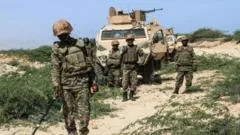
Since 2007, the UPDF has been a cornerstone of the international effort to stabilize Somalia. Ugandan forces were instrumental in the initial stages of the African Union Mission in Somalia (AMISOM), helping to secure the transitional government against Islamist insurgencies. Their involvement spanned several major military operations, including the reclamation of Mogadishu and other vital urban centers from militant control. By fighting alongside the Somali National Army, the UPDF helped secure strategic territories and essential government installations that remain central to the state's survival today.
What is the impact of the withdrawal on Somalia's security landscape?
The withdrawal places the primary burden of national security on the Somali National Army as the country faces a persistent threat from al-Shabab. This al-Qaeda-linked militant group has led a deadly insurgency in the region for more than two decades, targeting government stability and civilian populations.
The transition is intended to empower Somali institutions, but it occurs during a period of significant military reorganization. Currently, there are approximately 4,500 troops in Somalia under the African Union mission, complemented by roughly 2,000 troops deployed through bilateral agreements. The departure of Ugandan forces represents a significant reduction in the international security umbrella that has protected key areas for twenty years.
During recent diplomatic engagements, President Yoweri Museveni of Uganda emphasized the necessity of national unity for Somali leaders and citizens. He urged a collective front against the insurgency, noting that while the UPDF is exiting, the fight against al-Shabab remains a critical requirement for the country's future stability.
How have African Union missions evolved during this period?
The security architecture in Somalia has undergone several transformations, moving from direct combat support to institutional capacity building. This evolution is reflected in the shifting names and mandates of the African Union missions tasked with stabilizing the region.
The transition began with the African Union Mission in Somalia (AMISOM), established in 2007 to protect the transitional government. This was eventually succeeded by the African Union Transition Mission in Somalia (ATMIS), which focused on the gradual transfer of security duties to Somali forces. In 2025, ATMIS was replaced by the African Union Support and Stabilisation Mission in Somalia (AUSSOM).
AUSSOM's current mandate is specifically designed to strengthen Somali security institutions and prepare local forces to assume full responsibility for the nation's defense. However, this mission faces significant headwinds regarding its long-term viability and financial sustainability.
Funding challenges for AUSSOM
The future of the AUSSOM mission is currently clouded by significant financial uncertainty. As the international community contemplates a reduction in support, the mission must navigate a complex funding landscape. Plans are currently underway to wind down support from both the United States and the United Nations, which have historically provided critical resources for these peacekeeping efforts.
To address this potential vacuum, a 12-month transition plan is scheduled to begin in January. This period is intended to provide both the African Union and the Somali government with the necessary time to identify and secure alternative funding sources. Without a stable financial foundation, the ability of AUSSOM to fulfill its mandate of institutional strengthening may be compromised, potentially leaving a security gap during the final stages of the Ugandan withdrawal.
What diplomatic discussions preceded the withdrawal announcement?
The decision to begin the withdrawal followed high-level diplomatic meetings between the leadership of Uganda and Somalia. Last week, Somali President Sheikh Mohamud traveled to Kampala to meet with his Ugandan counterpart, Yoweri Museveni, to discuss the multifaceted relationship between the two nations.
The discussions were not limited to military matters; they also encompassed trade and economic ties, reflecting the broader bilateral relationship. However, the security situation remained a central pillar of the talks. Reports indicate that President Mohamud sought to persuade President Museveni to extend Uganda's military presence in the country, highlighting the concerns regarding the timing of the exit.
Despite these requests, the Ugandan leadership has maintained its commitment to the phased withdrawal. The transition is framed by the Ugandan military as a fulfillment of a promise to hand over security to "Somali brothers" after twenty years of significant sacrifice and combat operations.
Frequently asked questions
When will Uganda complete its military exit from Somalia?
Uganda plans to complete its full withdrawal from Somalia by the end of 2027. This timeline covers both the troops deployed through bilateral arrangements and those serving under the African Union's mission mandates, ensuring a phased handover of responsibilities.
What is the primary threat facing Somalia during this transition?
The primary security threat is the al-Shabab insurgency, an al-Qaeda-linked militant group. The group has conducted a prolonged and deadly campaign against the Somali government and its citizens for over twenty years, making the security transition particularly delicate.
Why is the AUSSOM mission facing uncertainty?
AUSSOM faces uncertainty due to planned reductions in funding from the United States and the United Nations. The mission is currently working under a 12-month transition plan starting in January to find alternative ways to finance its operations.
What was the role of the UPDF in Somalia since 2007?
The Uganda People's Defence Forces (UPDF) played a critical role in driving al-Shabab out of major towns like Mogadishu. They worked alongside the Somali National Army to recapture territory and secure vital government installations during various AU missions.
How many international troops are currently in Somalia?
There are approximately 4,500 troops serving under the African Union mission in Somalia, along with about 2,000 troops deployed through bilateral arrangements, totaling roughly 6,500 international personnel involved in the country's security.
Key takeaways
- Uganda will complete its full military withdrawal from Somalia by the end of 2027.
- The withdrawal follows a 20-year period of UPDF involvement in the Horn of Africa.
- AUSSOM faces potential funding gaps as US and UN support begins to wind down.
- A 12-month transition plan to secure new funding starts in January.
- Security responsibilities are being handed over to the Somali National Army.
Conclusion
The withdrawal of Ugandan forces marks a pivotal moment in the history of the Horn of Africa, signaling a shift from international peacekeeping to Somali-led security management. While the UPDF has been a foundational element of regional stability for two decades, the success of this exit depends heavily on the Somali National Army's readiness and the financial stability of the AUSSOM mission. As the international community moves toward reducing its footprint, the ability of the African Union to secure alternative funding will be the deciding factor in whether Somalia can maintain its hard-won territorial gains against the persistent al-Shabab insurgency.