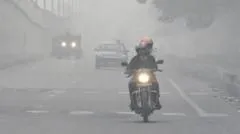
What causes the recurring Delhi air pollution every winter?
The seasonal spike in Delhi air pollution is driven by a complex interplay of meteorological conditions and human activities. As winter approaches, declining temperatures and reduced wind speeds create a phenomenon where pollutants are trapped close to the Earth's surface rather than being dispersed into the upper atmosphere.
Several key factors contribute to this toxic cocktail:
- Agricultural Residue Burning: Smoke from burning crop stubble in neighboring states significantly increases particulate matter.
- Vehicular and Industrial Emissions: Constant exhaust from cars, trucks, and factories provides a steady stream of pollutants.
- Construction Dust: Unregulated or heavy construction activity releases large amounts of fine dust into the air.
- Festive Activity: The use of firecrackers during major festivals further degrades air quality during the seasonal peak.
- Secondary Pollutants: Chemical reactions between sunlight, water vapor, and existing gases create harmful new particles.
Beyond these visible sources, experts note that coal and fly ash from brick kilns, along with the large-scale burning of urban waste, play significant roles in maintaining high pollution levels.
How is the Delhi government responding to the smog?
The Delhi government has introduced a Winter Action Plan, active from November 1 to February 28, to address the predictable surge in smog. This proactive approach aims to implement measures before air quality reaches unmanageable levels, a departure from previous years when interventions often arrived too late.
The current strategy includes several restrictive measures designed to curb emissions:
- Vehicle Restrictions: Limiting the entry of older, high-polluting vehicles registered outside Delhi and enforcing strict emission standard certifications.
- Construction Bans: Temporary halts on outdoor construction and demolition work to reduce dust levels.
- Work-from-Home Mandates: Encouraging offices to allow half of their staff to work remotely and implementing staggered timings to reduce commuter traffic.
- Parking and Public Transit: Increasing parking charges while promoting the use of electric vehicles and public transportation.
The Graded Response Action Plan (GRAP)
In addition to local government efforts, the federal Commission for Air Quality Management oversees the Graded Response Action Plan (GRAP). This system triggers increasingly stringent restrictions as pollution levels climb through specific stages. For instance, during the current cycle, the second stage of GRAP has been activated, which prohibits the use of diesel generators and the burning of coal or firewood to help stabilize the air quality.
Is the current pollution management effective?
While the existence of a structured roadmap is viewed as a positive development, experts express significant doubt regarding the actual execution of these policies. The gap between planning and enforcement remains a primary hurdle in cleaning the city's air.
According to Parthaa Bosu, a strategic adviser at the Environmental Defense Fund, while planning has improved, the level of execution has not seen a corresponding advancement. Furthermore, analysts suggest that the current focus is too narrow. Manoj Kumar, an analyst at the Centre for Research on Energy and Clean Air, argues that effective reduction requires setting specific emission targets for every major sector, including power generation and heavy industry, rather than just focusing on vehicle entry and construction.
A significant challenge also lies in the geographic nature of the problem. Because pollutants travel from neighboring states into the capital, Delhi's local measures can only achieve limited success. Solving the crisis requires a coordinated regional approach involving the wider northern Indian territory to manage transboundary smoke and dust.
What are the health and social impacts of the smog?
The impact of Delhi air pollution on human health is profound and documented by medical professionals. During the peak season, the Air Quality Index (AQI) frequently exceeds 300, categorized as "very poor," with some days hitting the domestic ceiling of 500. However, international monitors like IQAir have recorded much higher levels, sometimes approaching 1,000.
The health consequences are driven by PM2.5 particles, which are small enough to penetrate deep into the lungs and enter the bloodstream. Dr. Manoj Goel, head of the pulmonology unit at Fortis Memorial Research Institute, notes that this can trigger widespread inflammation and affect multiple organs. Short-term effects include:
- Persistent coughing and wheezing.
- Throat and eye irritation.
- Increased difficulty breathing.
- Exacerbation of existing heart and lung conditions.
The long-term outlook is even more concerning. A 2025 report from the Energy Policy Institute at the University of Chicago estimated that air pollution could reduce the life expectancy of Delhi residents by as much as 8.2 years. Beyond health, the pollution disrupts the economy and daily movement; commuters traveling between Delhi and satellite cities like Noida and Gurugram face massive delays due to vehicle checkpoints and traffic congestion caused by new restrictions.
FAQ: Delhi Air Pollution
How high can the AQI go in Delhi?
In Delhi, the domestic Air Quality Index (AQI) is capped at 500, which is classified as "very poor." However, international monitoring services have recorded much higher levels, reaching near 1,000 during extreme pollution episodes, indicating the air is far more toxic than local scales suggest.
What is the Winter Action Plan?
The Winter Action Plan is a government initiative active from November 1 to February 28. It includes measures such as banning certain construction activities, restricting high-polluting vehicles, and encouraging remote work to reduce the concentration of pollutants during the winter months.
How does pollution affect life expectancy in Delhi?
Air pollution significantly reduces longevity in the region. According to a 2025 report by the Energy Policy Institute at the University of Chicago, the high levels of particulate matter could potentially reduce the life expectancy of Delhi residents by up to 8.2 years.
Why does the pollution get worse in winter?
Winter weather creates meteorological conditions that trap smog. Falling temperatures and slower wind speeds prevent pollutants from dispersing, causing them to settle close to the ground where people breathe, exacerbated by seasonal activities like crop burning and festive firecrackers.
Can local measures alone fix the problem?
Local measures are often insufficient because pollutants travel from neighboring states into Delhi. Experts suggest that a holistic, regional approach involving all northern Indian states is necessary to address the transboundary nature of the smoke and dust.
Key takeaways
- Delhi's winter smog is caused by crop burning, vehicle emissions, and trapped pollutants.
- The Winter Action Plan runs from November 1 to February 28 to mitigate spikes.
- AQI levels often exceed 300, with international monitors recording levels near 1,000.
- Pollution may reduce Delhi residents' life expectancy by up to 8.2 years.
- Effective solutions require regional cooperation beyond Delhi's borders.
Conclusion
The return of toxic air in Delhi highlights a recurring crisis that transcends simple seasonal changes. While the government's Winter Action Plan represents a more organized approach to mitigation, the fundamental drivers—regional agricultural practices, industrial emissions, and meteorological traps—remain largely unaddressed. For the millions of residents, the smog is not just an environmental statistic but a daily threat to health and a significant disruption to economic and social life. Without integrated regional enforcement and sector-specific emission targets, the cycle of respiratory illness and diminished life expectancy is likely to persist each winter.