Which airlines and airports were affected by the recent threats?
At least 21 aircraft across various European carriers were impacted by a series of bomb threats on Thursday, November 6, 2026. The scale of the disruption spanned multiple countries, including Italy, France, Bulgaria, and the Czech Republic, as airlines scrambled to follow security protocols.
The following table summarizes some of the specific flight disruptions reported:
| Airline | Route/Origin | Outcome |
|---|---|---|
| Aer Lingus | Dublin to Rome | Diverted to Normandy, France |
| Finnair | Helsinki to Rome | Escorted by Italian fighter jets |
| Wizz Air | Milan to Warsaw/Bucharest | One diverted to Vienna, one landed in Bucharest |
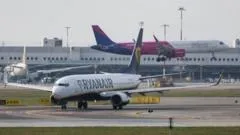
| Ryanair | Various (Bulgaria) | Three flights landed in Sofia/Plovdiv with fighter escorts |
| EasyJet | Newcastle/Glasgow to Prague | Met by police in Prague as a precaution |
| Aegean Airlines | Thessaloniki/Athens | Threats assessed as unfounded; flights proceeded |
In the United Kingdom, London Heathrow and Birmingham airports also reported receiving threats. However, Heathrow stated the threat was deemed not credible and posed no risk to passengers or staff. Birmingham Airport confirmed that emergency services and partners were immediately engaged to follow established safety processes.
Who is behind the "Fighters of the Male State" claims?
The threats received by Italian authorities via email were signed by a group calling themselves the "Fighters of the Male State." This entity claimed to be targeting a "feminist regime" and expressed a desire to "make our mark on history" by turning the skies red with explosions.
According to reports from Italian media and confirmation from Aeroporti di Roma, these communications targeted two inbound flights in Rome. While the group's identity remains unconfirmed, analysts have drawn parallels to a known extremist organization.
Potential links to Muzhskoi Legion
Experts suggest that the "Fighters of the Male State" may be a reference to "Muzhskoi Legion" (Male Legion), an ultra-right Russian group. This organization was banned by a Moscow court in 2021 due to its extreme views. Despite the ban, the group maintained a significant online presence, notably supporting the Russian invasion of Ukraine in 2022. However, the use of such names in email threats may not provide actionable intelligence for law enforcement, as the digital signatures could be fabricated to mislead investigators.
How are aviation authorities responding to these disruptions?
Aviation authorities and governments are treating the threats with high priority, even when the likelihood of an actual explosive device is considered low. The response involves a combination of police intervention, military escorts, and rigorous aircraft inspections.
In Bulgaria, the air force provided fighter jet escorts for three Ryanair flights landing in Sofia and Plovdiv. Similarly, an Italian Air Force fighter jet was utilized to escort a Finnair flight into Rome's Fiumicino airport. These measures are designed to ensure that if a threat is real, the aircraft is under constant surveillance and can be managed safely upon landing.
The UK government has emphasized its commitment to these protocols. UK Transport Secretary Heidi Alexander described the recent incidents as "malicious hoax threats" but noted that the government takes all such warnings seriously. Established processes are currently in place to differentiate between credible dangers and coordinated hoaxes.
What is the impact of these threats on passengers?
Passengers have experienced significant anxiety and logistical delays due to the sudden nature of the security alerts. The transition from a routine flight to an emergency situation often happens with minimal information provided to those on board.
Emily Noble, a passenger on the diverted Aer Lingus flight from Dublin to Rome, described the experience as "worrying." Initially told there was a "technical" problem, passengers were later informed of a security issue as the plane began circling for an unplanned landing at the Évreux-Fauville air base in Normandy. Noble reported hearing fighter jets and seeing one land behind their aircraft during the diversion. The passengers remained on board for two and a half hours while security personnel and sniffer dogs conducted thorough searches.
Beyond the psychological impact, these incidents cause significant travel disruption. Diverted flights require re-accommodation, and security screenings for baggage and aircraft can lead to lengthy delays at major hubs like Warsaw or Madrid.
What are the long-term risks to aviation security?
Aviation experts warn that the primary danger of frequent hoax bomb threats is not the immediate disruption, but the potential for long-term security degradation. There are two main concerns: complacency and diversion.
Professor Philip Baum, an aviation security expert at the University of Coventry, noted that while the industry manages multiple threats daily, the recent frequency is unusual. He warned that if hoax threats become too common, there is a risk that security personnel might become complacent, potentially leading to a real threat being overlooked. Furthermore, such hoaxes could be used as a "diversion" to draw security resources away from other, more serious activities.
Marco Chan, an aviation expert from Kingston University, suggested that these incidents might be part of a pattern of "cheap, deniable disruption." This type of activity is difficult to prosecute because the perpetrators can remain anonymous, yet it succeeds in causing economic and operational chaos across the European airspace.
Frequently asked questions
Are the recent bomb threats considered credible?
Most recent threats have been assessed as non-credible or unfounded by airport authorities and airlines. However, aviation protocols require that every threat be treated as real until a thorough physical inspection and security assessment are completed by the relevant emergency services and specialized teams.
What happens when a flight is diverted due to a threat?
A diverted flight is redirected to a nearby or designated safe airport, such as an air base. Once landed, passengers remain on board while police, military, or bomb disposal experts conduct searches with sniffer dogs and technical equipment to ensure no hazards exist.
Why were fighter jets used to escort certain flights?
Fighter jets are deployed as a precautionary measure to provide visual and tactical surveillance of an aircraft suspected of carrying a threat. This ensures the aircraft is protected and monitored by military personnel during its approach and landing at the destination airport.
Is there a specific group responsible for these hoaxes?
While a group calling itself "Fighters of the Male State" has claimed responsibility via email, their identity is not officially confirmed. Analysts suggest they may be linked to the banned Russian group Muzhskoi Legion, but authorities caution that these claims may be part of a broader hoax.
How do these hoaxes affect flight schedules?
Hoax threats cause significant delays through diversions, mandatory security screenings of passengers and baggage, and the grounding of aircraft for inspection. Airlines must then work to re-accommodate passengers on alternative flights, which can lead to widespread disruption across the aviation network.
Key takeaways
- At least 21 aircraft and multiple European airports were targeted by bomb threats in November 2026.
- The "Fighters of the Male State" claimed responsibility via email, targeting flights in Italy.
- Aviation authorities utilized fighter jet escorts in Italy and Bulgaria to manage suspected threats.
- Experts warn that frequent hoaxes could lead to security complacency or serve as tactical diversions.
Conclusion
The recent wave of hoax bomb threats across Europe highlights the vulnerability of the aviation sector to coordinated, low-cost disruption. While security protocols—including military escorts and intensive searches—effectively manage the immediate risks, the psychological and operational toll on passengers and airlines is substantial. As experts suggest, the danger lies in the potential for these hoaxes to desensitize security responses or mask more serious intentions. Maintaining robust, rigorous standards remains essential to ensuring that the frequency of these malicious hoaxes does not undermine the overall safety of European air travel.