What does the Kamyshuvakha bodycam footage reveal?
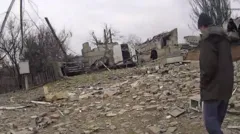
The released bodycam footage provides a harrowing first-person perspective of the Russian double-tap bombing in Kamyshuvakha, capturing the sequence of two distinct explosions. The video, recorded by a police officer who was killed during the incident, begins by showing the immediate devastation following an initial strike. Local residents are seen standing amidst the rubble of severely damaged buildings in the Zaporizhzhia region, appearing visibly shocked by the destruction.
As the footage progresses, a military official can be heard on a two-way radio warning ground units that additional glide bombs are being launched toward the village. In response to this warning, the officer on camera is heard urgently instructing civilians to seek cover in a shelter located at least two floors underground. The footage follows the residents as they move toward the safety of the structure, only for a second, massive blast to occur seconds later, at which point the recording abruptly ends.
BBC Verify has confirmed that this specific bodycam video was filmed at the same location as footage previously released by the Ukrainian State Emergency Service (DSNS), which documented the aftermath of Monday's assault. The synchronization of these visual records provides a consistent account of the rapid succession of the strikes.
How much damage was caused by the Russian glide bombs?
The scale of the destruction in Kamyshuvakha is characterized by the use of heavy aerial weaponry, specifically nine gliding bombs. According to President Volodymyr Zelensky, these weapons were deployed in two waves: the first strike targeted individuals gathered to receive humanitarian aid, while the second strike hit the rescuers and police officers who had arrived to assist the victims.
The technical specifications of the weapons used contribute significantly to the lethality of the event. Ukraine reported that some of the gliding bombs deployed during the attack weighed as much as 3,000kg. The impact of such heavy ordnance is evidenced by the massive crater documented by the DSNS, which illustrates the kinetic energy released during the strikes.
The humanitarian impact and search efforts
The attack targeted a site of critical civilian importance, specifically a shelter located near a local school that was serving as a distribution point for humanitarian aid. Because the strikes hit both the aid seekers and the subsequent emergency responders, the casualty count is expected to be high. President Zelensky stated that more than 30 individuals may still be trapped beneath the rubble as search operations entered their third day following the Monday attack.
What is the political reaction to the Kamyshuvakha attack?
President Volodymyr Zelensky has characterized the bombing as an "insane attack" and categorized it as one of thousands of war crimes committed by Russian forces. The Ukrainian leadership has expressed frustration regarding the international community's response, with Zelensky noting that there has been "very little reaction from the world" to this specific incident.
The Russian military has maintained its silence on the matter, providing no public comment regarding the strikes in Kamyshuvakha. This lack of response comes amidst a broader pattern of intensified Russian attacks, which analysts note have increased since trilateral peace talks were suspended in February. This escalation coincides with a period where Kyiv has faced significant challenges in defending against missile strikes due to a shortage of Western-supplied interceptors.
How do these events relate to the upcoming peace negotiations?
The devastation in Zaporizhzhia occurs against a backdrop of high-stakes diplomacy, as Ukraine prepares for trilateral negotiations involving Russia and the United States. President Zelensky confirmed he held a detailed, 90-minute conversation with US peace envoys Steve Witkoff and Jared Kushner to prepare for these discussions.
The upcoming trilateral talks are scheduled to take place in Abu Dhabi, United Arab Emirates, on November 10-11. While these meetings aim to find a path toward ending the conflict, military analysts remain cautious. The prevailing sentiment among experts is that no major diplomatic breakthrough is expected during these specific sessions in the UAE capital.
Post-war reconstruction and security guarantees
Parallel to the peace talks, Ukrainian leadership is engaging in extensive discussions regarding the long-term stability and recovery of the nation. During a visit to Spain, Zelensky reported a "meaningful" meeting in Brussels with a broad coalition of international partners. This group included representatives from:
- The United States and the European Union
- France and Germany
- Great Britain
- NATO and the World Bank
These discussions focused heavily on two pillars: the logistics of post-war reconstruction and the establishment of robust security guarantees for Ukraine to prevent future aggression.
Frequently asked questions
What is a "double-tap" bombing?
A double-tap bombing is a military tactic where a second strike is launched at the same location shortly after an initial explosion. This method is designed to target first responders, rescuers, and civilians who have gathered at the site to assist victims of the first strike, significantly increasing the casualty rate.
What weapons were used in the Kamyshuvakha attack?
The attack involved nine Russian gliding bombs. According to Ukrainian officials, some of these bombs were exceptionally heavy, with weights reaching up to 3,000kg. These aerial bombs were used to strike both a humanitarian aid distribution point and an underground shelter used by local residents.
When and where are the trilateral peace talks happening?
The trilateral negotiations involving Ukraine, Russia, and the United States are scheduled to take place on November 10-11. The meetings are set to be held in Abu Dhabi, in the capital of the United Arab Emirates, following a suspension of such talks earlier in the year.
Who are the US envoys involved in the peace talks?
President Zelensky confirmed that he spoke extensively with Steve Witkoff and Jared Kushner. These individuals are serving as peace envoys for US President Donald Trump and are key figures in the preparations for the upcoming negotiations in Abu Dhabi.
What is the status of the search operation in Kamyshuvakha?
As of the third day following the Monday attack, search operations are ongoing to recover victims from the rubble. President Zelensky has indicated that more than 30 people may still be trapped under the debris caused by the heavy Russian glide bombs.
Key takeaways
- The Kamyshuvakha bombing killed at least 40 people using a double-tap strike method.
- Nine Russian glide bombs, some weighing 3,000kg, were used in the attack.
- Bodycam footage confirmed the second strike hit a shelter after residents sought cover.
- Trilateral peace talks between Ukraine, Russia, and the US are set for November 10-11.
- Diplomatic discussions in Brussels are currently addressing post-war reconstruction and security.
The intersection of battlefield violence and diplomacy
The recent tragedy in Kamyshuvakha underscores the brutal reality of the ongoing conflict, where humanitarian sites and emergency responders are directly targeted. The use of heavy glide bombs in a double-tap fashion highlights a pattern of tactics that complicate both civilian survival and rescue efforts. As the world watches these developments, the focus shifts to the upcoming Abu Dhabi negotiations. While the diplomatic path remains fraught with skepticism and uncertainty, the discussions regarding reconstruction and security guarantees in Brussels suggest that Ukraine is simultaneously preparing for both the end of active hostilities and the long, difficult process of national recovery.