What were the conditions like for Bu and Tyapa before their rescue?
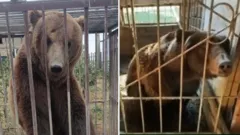
The two brown bears lived in environments characterized by extreme confinement and severe neglect in the Republic of Dagestan. Bu, a former circus bear, had endured years of restricted movement within a small indoor cage as a result of being forced to perform for entertainment. Tyapa’s situation was arguably more dire; he was kept in a roofless cage measuring only 2.5m by 2.5m by 2m, a space so low that he was unable to stand upright. This lack of overhead cover left him vulnerable to the extremes of both blistering summer heat and harsh winter temperatures.
Beyond the physical limitations of their cages, the bears suffered from a lack of basic necessities and looming threats to their lives. Tyapa reportedly had no dedicated water dish and was forced to rely on a hose for hydration. According to Killian McLaughlin, the founder of Wild Ireland, Tyapa was being raised specifically for eventual taxidermy. When the rescue team finally reached them, the physical and mental toll was evident. Both bears were severely malnourished and exhibited significant signs of psychological trauma. Furthermore, blood tests conducted during their initial rescue revealed serious kidney issues, which specialists linked to prolonged periods of dehydration.
How did geopolitical conflicts delay the rescue mission?
The rescue journey of Bu and Tyapa was repeatedly stalled by major international conflicts that closed vital transport corridors. Originally, the team intended to move the bears through Ukraine, but Russia's invasion of the country in February 2022 rendered this route impossible. This forced the organizers to seek alternative logistical paths, eventually looking toward the Middle East to facilitate the transfer from Russia to Europe.
However, the second major disruption occurred in February 2026. An escalating conflict involving Iran led to widespread airspace closures and significant flight disruptions across the Middle East region. These geopolitical shifts meant that what should have been a straightforward animal transfer became a half-decade struggle involving a massive network of professionals. The final successful operation required the coordination of more than 100 people, including:
- Volunteers and animal welfare advocates
- Legal experts and officials in Russia, the UAE, and Ireland
- Veterinarians and animal transport specialists
- Cargo teams and logistics experts
The process began in earnest in late October 2025, when Dima and Yana Kim from the St. Petersburg-based Tiger House undertook a 36-hour drive to Dagestan. The bears had to be extracted from rusting steel cages, sedated, and placed into secure crates for transport to Tiger House, where they underwent essential veterinary care and quarantine before their eventual flight from Moscow via Abu Dhabi to Dublin in August.
What is the impact of the new habitat at Wild Ireland?
Since arriving at the Wild Ireland sanctuary in Burnfoot, County Donegal, both bears have shown remarkable signs of physical and psychological recovery. The sanctuary, which opened in October 2019, provides a diverse landscape of woodland, water, and grass designed to encourage natural movement. Killian McLaughlin noted that the primary goal of the rehabilitation is to reconnect the bears with a natural environment, allowing them to get their "paws into the soil" and explore freely.
The environmental changes have yielded measurable health benefits. According to McLaughlin, both bears have gained weight, their coats have improved in quality, and most importantly, follow-up blood tests indicate that their kidney function has returned to normal levels. The habitat is designed to respect the bears' need for autonomy, offering sheltered areas where they can retreat from view if they require privacy.
Promoting natural behaviors through enrichment
Rehabilitation at Wild Ireland extends beyond simple physical space; it involves active cognitive stimulation. To help the bears adjust to their new surroundings, the staff employs specific enrichment techniques. Chloe McElhatton, a zoology graduate and team member at the sanctuary, explained that the team hides food throughout the bear habitats. This practice encourages the bears to engage in foraging, a natural behavior that was likely suppressed during their years of captivity. By searching for food, the bears build confidence and become more comfortable in the open space, facilitating both mental and physical healing.
How are visitors and the local community reacting to the bears?
The presence of Bu and Tyapa has become a significant point of interest for visitors to the Wild Ireland sanctuary. For many, seeing the bears serves as a testament to the success of international animal rescue efforts. Visitors from various backgrounds have noted the impressive scale of the animals, with some expressing a deep emotional connection to their survival story.
Liam, a visitor from France, described the bears as "very big and very impressive," noting them as his favorite animals at the park. Local residents have also shown long-standing support for the facility. Chris Roberts, a resident of nearby Manorcunningham, has visited the site since its inception in 2019. He expressed delight at seeing the bears in person, particularly given the "awful conditions" they endured in Russia. The bears' successful integration into the Donegal landscape has turned their rescue journey into a celebrated milestone for the sanctuary and the local community.
Frequently asked questions
Where is the Wild Ireland sanctuary located?
Wild Ireland is located in Burnfoot, County Donegal, Ireland. The sanctuary opened in October 2019 and serves as a safe haven for a variety of rescued animals, including brown bears, wolves, lynx, and monkeys.
How long did the rescue of Bu and Tyapa take?
The entire rescue mission spanned approximately five years. The process began when Killian McLaughlin first learned of the bears in 2021 and concluded with their arrival in Ireland in August 2026, following significant delays caused by international conflicts.
What health issues did the bears face upon rescue?
Upon their initial rescue, both bears were severely malnourished and showed signs of psychological trauma. Additionally, blood tests revealed serious kidney problems, which were attributed to the prolonged dehydration the bears experienced in their previous confinement.
Who was involved in the transport of the bears?
The operation involved more than 100 people. This international team included veterinarians, animal transport specialists, lawyers, cargo teams, and officials from Russia, the United Arab Emirates, and Ireland, as well as volunteers.
How does the sanctuary help the bears adjust?
The sanctuary uses environmental enrichment, such as hiding food to encourage natural foraging behaviors. The habitat also provides woodland and water, along with sheltered areas that allow the bears to retreat and maintain privacy if they choose.
Key takeaways
- The rescue mission of Bu and Tyapa took five years and involved over 100 people.
- Geopolitical conflicts in Ukraine and the Middle East caused major delays in the bears' transport.
- Both bears showed significant health improvements, including restored kidney function and weight gain.
- Wild Ireland provides a naturalistic habitat in County Donegal to promote foraging and autonomy.
Conclusion
The successful relocation of Bu and Tyapa from the restrictive cages of Dagestan to the expansive woodlands of Ireland marks a triumph of persistence over geopolitical adversity. Through the coordinated efforts of international specialists and the dedicated staff at Wild Ireland, these bears have transitioned from victims of extreme neglect to thriving inhabitants of a natural sanctuary. While their past was defined by confinement and the threat of taxidermy, their future in Donegal offers the opportunity for a full, dignified, and natural life among the trees and grass.